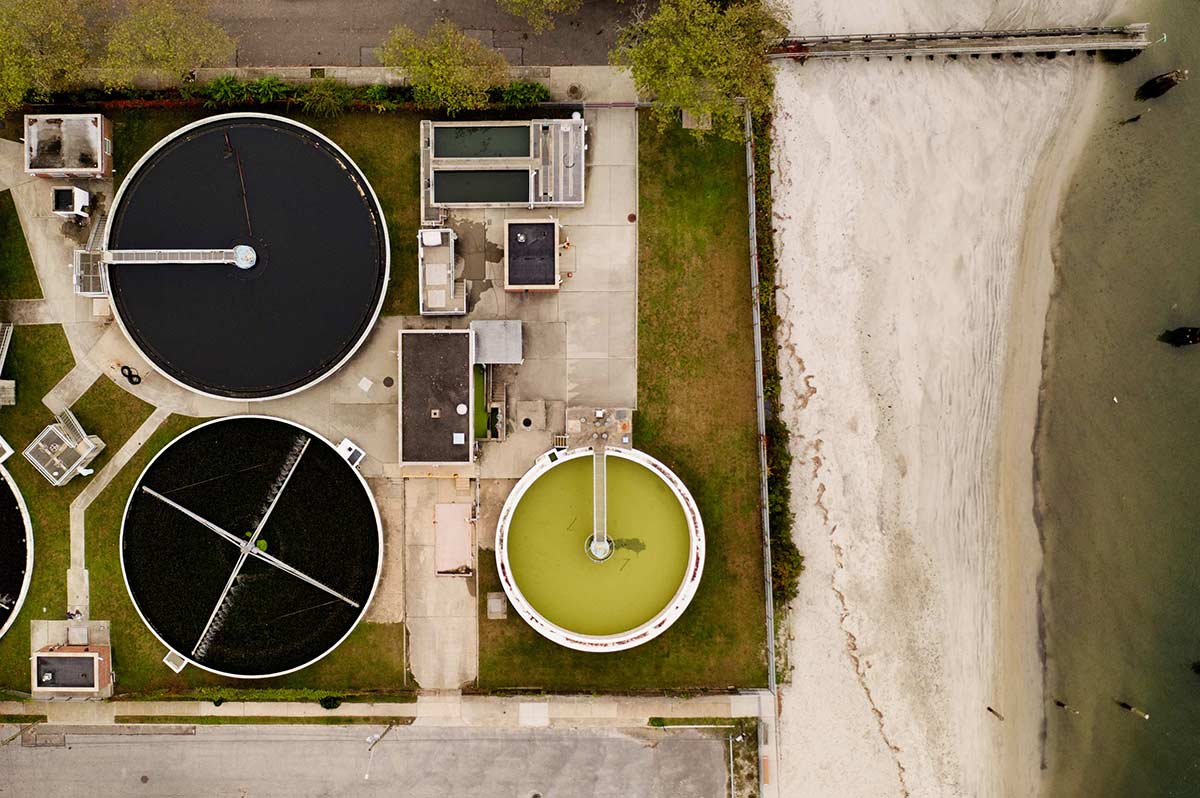
Various types of biological treatment technologies and process arrangements are utilized. Regardless, a waste stream representing overpopulation of bacteria, used to digest the sewage, is “wasted” requiring:
Dewatering and Disposal
Land Application as a Fertilizer Amendment
Further Treatment in Aerobic or Anaerobic Digesters
The Vacom Flash Hydrolyzer provides technical and economic benefits for each of the three options:
Dewatering and Disposal
The Vacom Flash Hydrolyzer ruptures the single cell walls of the bacteria releasing internal cellular water, which allows for enhanced mechanical dewatering.
The result is filter cake ranging from 30-60% versus 18-20% solids by weight.
The benefit of producing higher solids in filter cakes is substantial considering the cost of transportation and disposal into a landfill.
Land Application as a Fertilizer Amendment
The Vacom Flash Hydrolyzer ruptures the bacteria cells using boiling temperatures and flash pressure drop, which kill the pathogens.
The result is a treated sludge capable of safe land application as a fertilizer amendment whether as a liquid or dewatered sludge.
Further Treatment in Aerobic of Anaerobic Digesters
Aerobic and anaerobic digesters are used to stabilize the sludge and slightly reduce the resulting digester waste solids (digestate). In the case of anaerobic digesters, methane is recovered as Renewable Natural Gas (RNG).
The Vacom Flash Hydrolyzer can be utilized IN FRONT or AFTER the digester.
In front of the digester
the sludge viscosity is reduced allowing for better digester mixing
In the case of anaerobic digesters, 25% more recoverable RNG is available
After the Digester
All the benefits of pathogen destruction and enhanced dewatering are still available.
Regardless of how the Vacom Flash Hydrolyzer is deployed, the capital cost, operating cost and footprint is less than competing systems including Cambi.
Contact us to learn more or schedule a pilot test.
Bringing innovative solutions to the problem of municipal and industrial sludge management.
THE PROBLEM:
At large wastewater treatment plants, anaerobic digesters manage the biosolids produced at the plant, but as a municipality grows, these systems reach maximum operating capacity, and it is expensive to install new digesters.
Digesters can be susceptible to ammonia inhibition and toxicity, a serious problem when too much ammonia is in the waste stream, possibly even leading to a complete failure of an anaerobic digester.
At smaller wastewater treatment plants, anaerobic digesters may not be present and aerobic sludge is dewatered directly. However, traditional dewatering systems still produce a wet sludge that is often 80% water content! It is usually landfilled at high trucking and disposal costs.
Dewatered sludge from small wastewater treatment plants and even some larger plants struggle with pathogen regrowth in the biosolids that are hauled off for landfill disposal. This is an unfortunate problem that can endanger the health of entire communities.
THE SOLUTION:
Our system performs hydrolysis quickly and efficiently which eliminates the space required for a digester’s initial digestion step. In essence this provides more available space in the digester for processing. Existing systems can process a higher volume without new construction.
Our system, while hydrolyzing, also aims to remove a portion of the ammonia in the incoming wastewater. Recovered ammonia can be collected while the sludge heading for digestion is lower in ammonia content.
Smaller wastewater treatment plants can benefit greatly from hydrolysis of their sludge to provide a complete pathogen kill prior to dewatering. The hydrolyzed sludge will dewater significantly better using the plant’s existing dewatering technologies and the sludge will be safe for reuse options instead of just landfilling.
With a Vacom Hydrolyzer you can…
1. Enhance dewatering after aerobic digestion
2. Enhance production rate in an anaerobic digester
3. Capture ammonia
4. Eliminate pathogens
The Vacom Solution for Municipal Management
Hydrolyzing Waste Activated Sludge
Vacom Systems specializes in the design of mechanical vapor recompression evaporators. However, Vacom has redesigned its proprietary technology and applied it to the processing of waste activated sludge (WAS).
As an example: A 20 MGD Wastewater Treatment Plant may:
Dispose of the sludge solids at a landfill after dewatering through a belt press.
Use the Vacom system to create a Class A product that can dewater to approx. 50%
Recover ammonia as a valuable biproduct.
Contact us to learn more or schedule a pilot test.